
Sealed Box Calculator
Enter the driver parameters and target Qtc for net box volume, or enter volume to calculate Qtc.
Your worksheet
Choose an example or enter measurements, then calculate.
Your volume ledger, drawing and fit checks will appear here. No dimensions are assumed.
Last updated
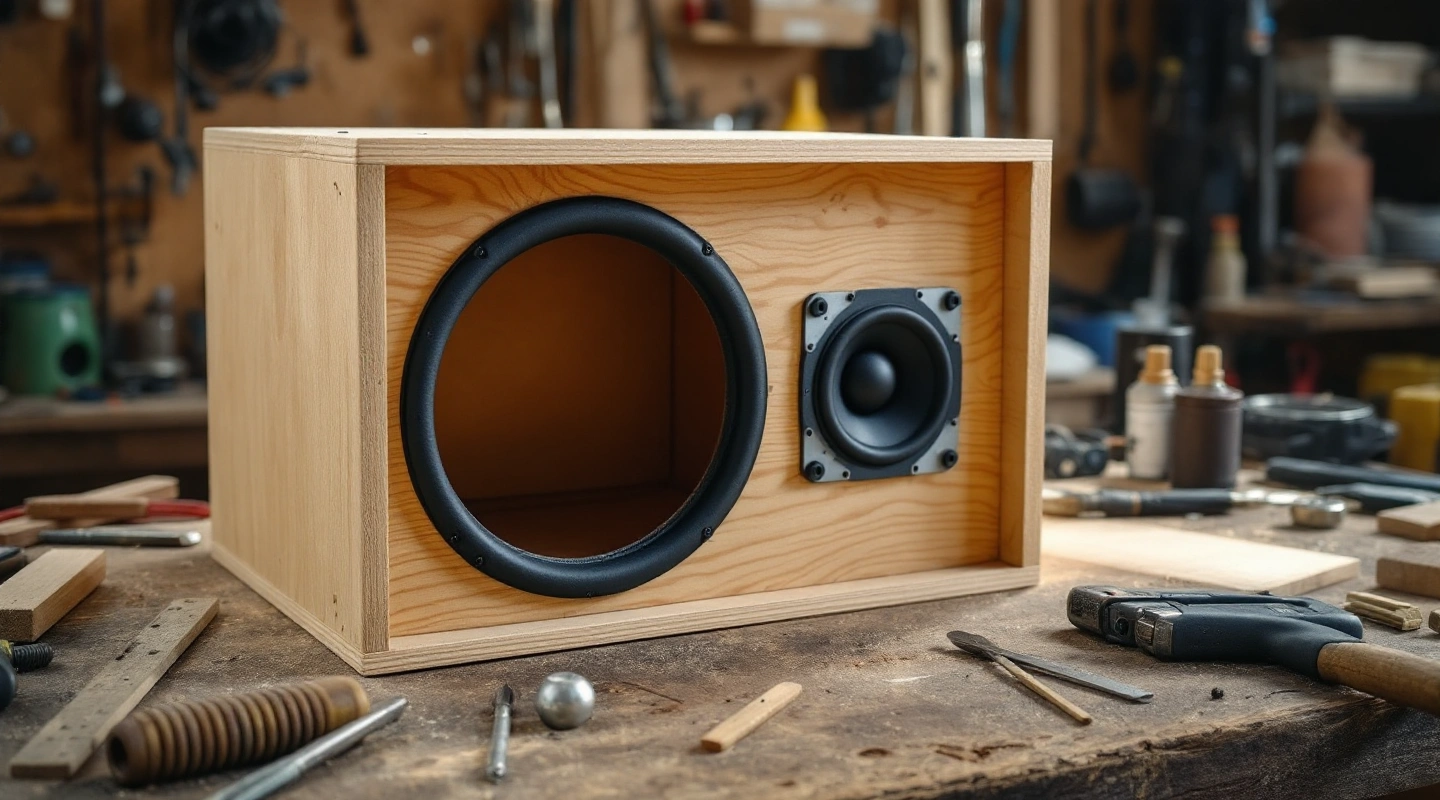
This sealed box calculator explores ideal net volume, system Qtc and frequency from an exact driver's small-signal parameters. Choose a target Qtc to solve volume, or enter a known net volume to work out the alignment. Keep the result separate from a maker's published box design.
Enter stated Fs, Qts and Vas for the same model and revision. A target Qtc must exceed Qts to produce a finite positive box in this ideal model. Net volume excludes installed parts. For identical drivers in a shared chamber, their Vas contributions add. The result omits cabin gain, fill adjustments, large-signal excursion and power limits.
On this page
Choose the sealed box calculator mode
Target-Qtc mode calculates required net airspace. Known-volume mode calculates ideal Qtc, Fc and F3 from a measured or chosen net cavity. These are acoustic alignment tasks. Use the homepage box planner afterward to turn a target into shell sizes and a panel worksheet.
Keep net volume per chamber stated. Identical drivers sharing one cavity use their combined Vas. Separate equal chambers are computed one at a time, then their total required airspace is shown. The solver does not cover mixed drivers, isobaric loading or passive radiators.
Enter matching driver parameters
Fs is the driver's free-air frequency in hertz. Qts is its total small-signal Q. Vas is the equivalent air compliance volume. Copy all three from the same exact model document. Qes, Qms and Qtp are other labels, not substitutes for Qts.
Use the stated units for Vas. Convert it to the same volume unit as the box before dividing. Save the source URL and revision with the inputs so someone else can repeat the calculation.
No diameter-only preset supplies those parameters. The loadable math example is clearly synthetic. The optional JL source example keeps its published values and the discrepancy found in ideal Qtc, rather than presenting them as a new measured driver test.
Worked equation and inverse check
Let alpha = Vas_total/Vnet. The ideal relations are Qtc = Qts × √(1+alpha) and Fc = Fs × √(1+alpha). Solving the first for volume gives Vnet = Vas_total/((Qtc/Qts)²−1).
For a synthetic single driver with Vas 50 liters, Qts 0.4 and Fs 30 Hz, choose Qtc 0.8. The denominator is 3, so the required net volume is 16.666667 liters. Substitution back gives Qtc 0.8 and Fc 60 Hz. This is an arithmetic example, not a recommended real driver.
If target Qtc is equal to Qts, the denominator is zero and volume tends toward infinity. Below Qts, it would be negative. The calculator rejects both rather than displaying a zero or negative cabinet as a usable plan.
The Lars Holmdahl closed-box note, dated 18 September 2011, supplies the public equation reference. The forward and inverse checks check the algebra under its ideal model.
Understand Fc and F3
Fc is the ideal system frequency from the relation above. F3 is the frequency at which the ideal response is 3 dB below its high-frequency reference. They are not interchangeable labels and are not a vehicle's measured low-frequency cutoff.
With a = 1/(2Qtc²)−1, the relation used here is F3 = Fc × √(a+√(a²+1)). At Qtc equal to 1/√2, F3 equals Fc. At Qtc 0.5, the computed ratio F3/Fc is about 1.553774, matching the source table's rounded 1.554.
For the synthetic Qtc 0.8 example above, F3 is about 53.829605 Hz. That result belongs to the ideal response equation. The calculator does not add cabin gain or infer a listening result from it.
Compare with the maker
The JL 12W0v3-4 manual gives Fs 28.43 Hz, Qts 0.670 and Vas 2.530 cubic feet. At its 1.375-cubic-foot net target, these inputs yield ideal Fc about 47.9111 Hz and Qtc about 1.1291. The manual prints Fc 47.91 and Qtc 1.179.
Fc agrees at display rounding; Qtc does not. Label the manual's figure as published and the equation result as computed. The JL worked guide records this mismatch. It also checks a separate difference between the listed outside dimensions and net volume.
The mismatch does not prove a measured correction to the driver or manual. Nor does this ideal model replace the maker's full design guidance. It explains one defined relationship so you can compare assumptions honestly.
Sealed box calculator limits and next steps
The model treats the driver parameters as fixed and the box as ideal. It applies no built-in fill correction, leakage loss or thermal adjustment. It cannot prove excursion, safe power or vehicle response. Keep those outputs unknown rather than inferring them from a low Qtc.
Print keeps input parameters, volume, assumptions and source identity. Save a local JSON file to repeat the math later. Formula version 1.0.0 uses full precision internally and rounds only for display.
After choosing a stated target, send its net airspace to the box planner. Add physical driver and inside-part displacement there. A small-signal airspace result is not yet a cut sheet or a checked mounting layout.
FAQ
Is Qtc 0.707 always best?
It is a particular math alignment in the ideal model, not a fixed preference or vehicle target. Read the exact maker's design and check the full system. This tool does not model the cabin or predict listening preference. Keep the chosen Qtc labeled as an input rather than a proved optimum.
Can I use a target below Qts?
Not for a finite positive sealed box in this relation. The denominator in the volume equation is zero at equality and negative below it. The calculator rejects those inputs. Check that you copied Qts rather than another Q label before treating the rejected result as a driver limitation.
What changes with two identical drivers?
In one shared chamber, the Vas terms add, so the required total airspace doubles for the same ideal target. Separate equal chambers are computed once per chamber, then totaled. Physical driver displacement and divider material still belong in the later layout ledger. Mixed or isobaric arrangements are outside this solver.
Does the computed volume include the driver?
No. It is ideal net compliance airspace. A new empty cavity needs the actual occupied driver and other deductions added during the layout step. Do not add those parts to a maker's target that already includes them. Keep the target's convention visible when moving between the two calculators.
Verdict
Use the sealed box calculator to compare an ideal alignment with exact source inputs. Keep the maker's figures in a separate record. Then check construction and mounting in the box planner.