
Wedge Subwoofer Box Calculator
Enter the width, height, two depths and wall thickness for a sloped-box airspace ledger.
Your worksheet
Choose an example or enter measurements, then calculate.
Your volume ledger, drawing and fit checks will appear here. No dimensions are assumed.
Last updated
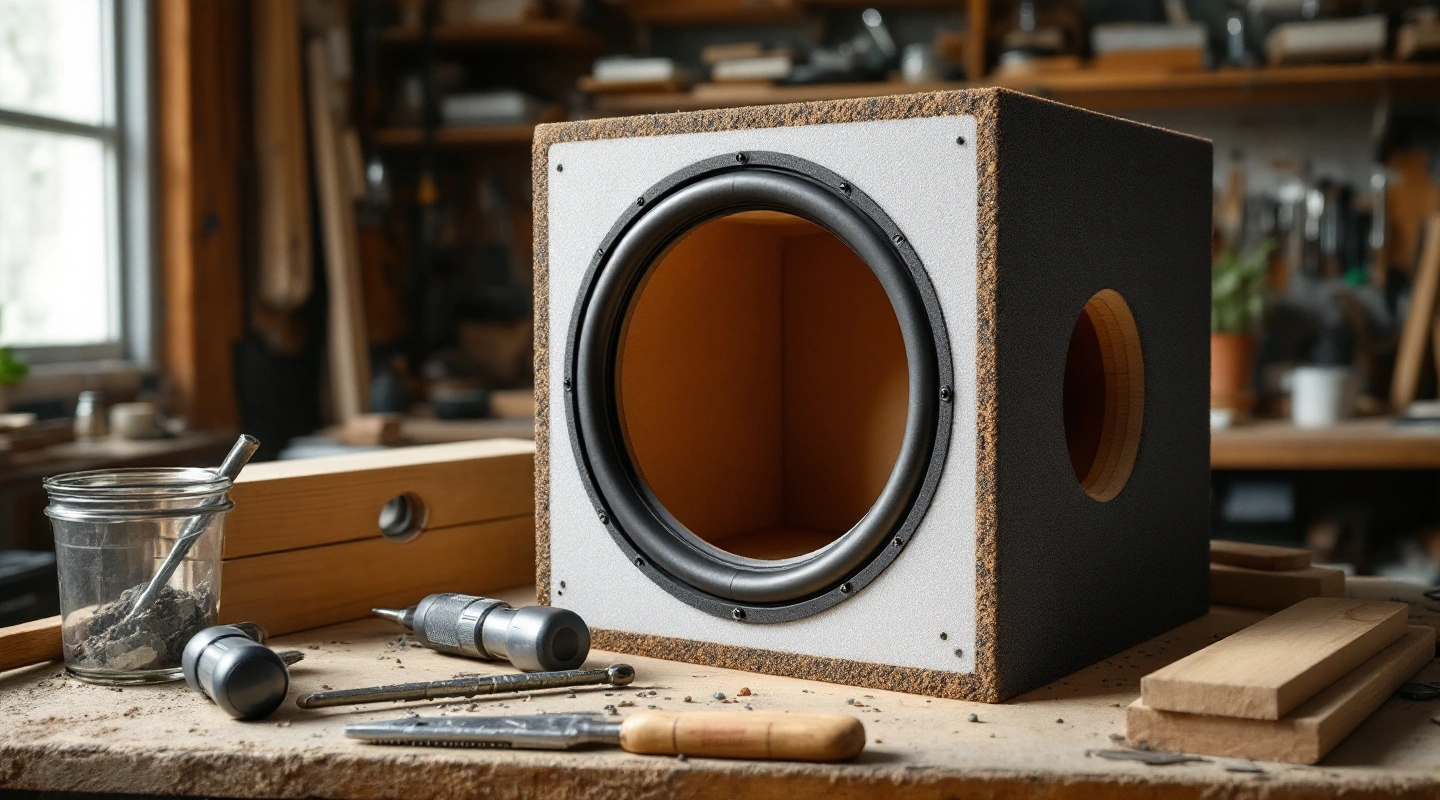
This wedge subwoofer box calculator measures a sloped box's cavity and remaining airspace. Choose known inside sizes or an outside outline with measured wall thickness. The worksheet assumes a vertical front, horizontal top and bottom, and one sloping rear wall.
For inside dimensions, multiply width by height and the average of top and bottom depths. For outside dimensions, offset the sloping rear wall along its normal before finding the inner depths. Subtract known installed parts afterward. Unknown displacement stays unknown. This volume worksheet does not choose bevel cuts or establish driver fit.
On this page
Choose the wedge box calculator measurement mode
Inside mode is the simpler job when you can reach the finished cavity. Enter the inner width and height, plus horizontal depths at its inner top and bottom. The width must remain constant across the wedge. Tapered side walls need another geometric model.
Outside mode uses outside width and height, bottom depth and top depth. Enter normal wall thickness and the full front thickness. A sloping rear wall's normal thickness is not the horizontal distance it removes, so subtracting twice the wall thickness from each depth is generally wrong.
Driver count and space taken up let you work out per-driver space for identical drivers sharing a chamber. Brace, terminal and port deductions must describe actual intrusions. Enter a checked zero clearly; a blank field keeps final net airspace incomplete.
Worked sloped-wall example
Load the synthetic example: outside width 20 inches, height 12, bottom depth 12 and top depth 8. Every wall is 0.75 inches thick, including the front. The inner width and height become 18.5 and 10.5 inches.
The parallel rear-wall offset gives inner depths about 10.209431 and 6.709431 inches. Averaging those depths and multiplying by the inner width and height yields 0.950952 cubic feet gross. The rear slope is about 18.435 degrees from vertical.
For an illustrative sealed deduction ledger, use 0.040 cubic feet for the driver, 0.020 for braces and 0.005 for terminals. Net airspace becomes 0.885952 cubic feet. These are stated example inputs. They do not recommend a box for any unnamed driver.
Wedge box calculator formulas and limit checks
For inside sizes, V = Wi × Hi × (db+dt)/2. In inch units, divide by 1728 for cubic feet. This is the area of a trapezoid multiplied by constant width.
For outside sizes, let k = (Dt−Db)/H. Offset the rear plane by t√(1+k²) horizontally. At inner bottom height t, the inside depth is Db+kt−t√(1+k²)−b. At inner top height H−t, it is Db+k(H−t)−t√(1+k²)−b.
These offsets were derived from the parallel-line distance relation. With equal top and bottom depths, the result reduces to the rectangular formula. With zero wall thickness as a math limit, it reduces to the outside trapezoidal prism. The KICKER construction guide supplies the basic interior-volume context.
Intersecting inner planes or nonpositive inside dimensions leave no valid cavity. The tool also rejects nonfinite numbers and fractional driver counts. A positive volume can still have an invalid mounting layout. The tool therefore does not infer driver fit from volume alone.
Print, save and plan the joints
Print the dimension ledger and side profile without an account. Save a local file to keep inputs, units and formula version 1.0.0. Check imported values before reusing them. The calculator does not create a public saved-plan page.
The worksheet deliberately omits built-in bevel settings. Panel lengths depend on which edges cap or fit between the others. Draw the actual joint section before cutting, then compare the dry-fit cavity with the math. Read how to build a wedge for that sequence.
FAQ
Can both the front and rear slope?
That is outside this worksheet's layout. The front here is vertical, and the rear is the only sloping wall. A second slope needs its own offset planes and cavity profile. Do not enter its outside depths as if the front were vertical, because the resulting airspace could be wrong.
Does the result include driver displacement?
Only when you enter the physical driver displacement and count. Braces, terminals and any vent need their own entries. If one is blank, net airspace stays unknown while gross cavity can still be shown. Do not use cone swept volume in place of the driver's physical occupied space.
Can I use this for a ported box?
It can supply the geometric cavity and a deduction ledger. The vent's acoustic design remains a separate job requiring true net airspace, clear section, effective length and its stated corrections. A positive wedge volume does not prove that the port fits or that the alignment suits the driver.
Why is there no built-in cut list?
The geometry defines the air region but does not choose the joints. A butt joint, bevel or edge-capping change can need different finished panels. Keep that distinction visible. Draw the chosen joint in section before turning the measured profile into saw settings for the actual pieces.
Verdict
Use the wedge subwoofer box calculator for a sloped-wall volume ledger. Design the joints and mounting layout as separate tasks. Transfer a documented net target to the rectangular planner if a straight shell may fit instead.