
3 Enclosure Choices: Ported vs Sealed Subwoofer in 2026
As an Amazon Associate, this website earns from qualifying purchases.
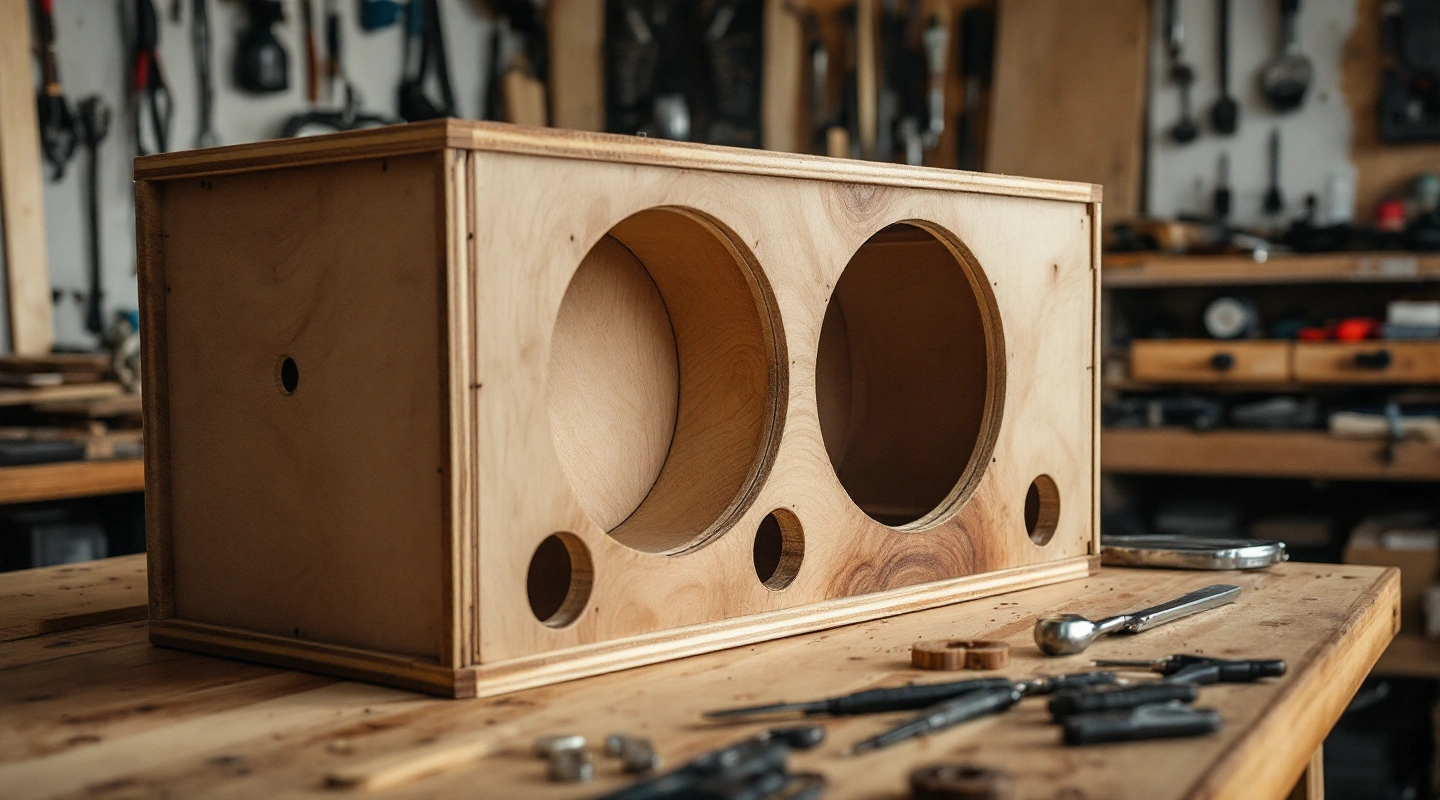
The short answer
For a ported vs sealed subwoofer choice, compare complete alignments for the same driver. The TR12S is the sealed candidate; the 12SQV and SK1X12V offer different vented volumes. Their labels do not establish a listening winner.
Our top 3 picks
- 1Sealed branch
 Goldwood TR12S sealed enclosure
- One unloaded 12-inch position
- 11-inch cutout; 11.75-inch mounting depth
- Published enclosure volume: 1.25 cubic feet
- 2Smaller vented branch
 Atrend 12SQV vented enclosure
- One unloaded 12-inch position
- Maker lists 1.2 cubic feet net and 36 Hz
- Maker lists 3/4-inch material
- 3Larger vented branch
 Skar SK1X12V vented enclosure
- One unloaded 12-inch position
- 2 cubic foot airspace label; 36 Hz tuning
- 11-inch cutout; 13.75-inch mounting depth
#1. Goldwood TR12S: single sealed
Goldwood TR12S sealed enclosure
Our verdict:
Sealed branch
A useful starting point when the driver calls for this size of sealed airspace.
Keep in mind: Its bare volume label must be checked against the driver's own target convention.
View on Amazon- One unloaded 12-inch position
- 11-inch cutout; 11.75-inch mounting depth
- Published enclosure volume: 1.25 cubic feet
The TR12S is our sealed branch in this ported vs sealed subwoofer comparison. It has one unloaded 12-inch position. Goldwood states 1.25 cubic feet of enclosure volume, an 11-inch cutout and 11.75 inches of mounting depth.
There is no intentional tuning vent to fit into the shell. That removes the vent geometry from this particular decision. It does not remove the need to check net airspace, rear clearance, terminal projection or the driver's own limits. A sealed label is not proof that the finished joints are leak-free.
The box has a slanted rear wall. If the driver's motor reaches toward that wall, check the depth at the actual mounting center. The listed maximum depth is not a drawing of the motor's whole clearance envelope. Confirm the volume basis before using this enclosure in an acoustic model.
Choose this branch when the driver's sealed recommendation suits the box and the simpler physical layout helps your build. Do not choose it because sealed boxes are claimed to sound better in all cases. We have no listening or response measurements that could support that ranking.
#2. Atrend 12SQV: smaller single vented
Our verdict:
Smaller vented branch
The maker gives a net volume and tuning, which helps compare an exact driver plan.
Keep in mind: Resolve the catalog-versus-maker fit measurements before relying on a close mounting fit.
View on Amazon- One unloaded 12-inch position
- Maker lists 1.2 cubic feet net and 36 Hz
- Maker lists 3/4-inch material
The Atrend 12SQV offers a single-driver vented layout. The manufacturer states 1.2 cubic feet net and 36 Hz tuning. This gives you an alignment starting point to compare with the exact driver's vented instructions.
Net volume and a tuning figure are useful, but neither supplies a full response curve. The driver parameters and vent dimensions still matter. So do losses and setup. A box with a 36 Hz label need not have its lowest usable output or its response peak at 36 Hz.
Its maker page and catalog differ on width and mounting depth. The maker gives 16 inches and 17.9 inches; the catalog gives 16.25 inches and 17 inches. Keep that conflict visible. Do not use whichever value makes the driver or vehicle pass a close fit check.
Use this branch for a smaller vented target once the fit data is clear. Unlike the sealed TR12S, it needs room at the port mouth. Check both ends. Then follow the driver's filter guide for the whole design.
#3. Skar SK1X12V: larger single vented
Our verdict:
Larger vented branch
Consider this box when the exact driver's vented plan matches its size and tuning.
Keep in mind: Its volume convention, installed clearances and driver match still need confirmation.
View on Amazon- One unloaded 12-inch position
- 2 cubic foot airspace label; 36 Hz tuning
- 11-inch cutout; 13.75-inch mounting depth
The SK1X12V gives a larger vented choice. Skar identifies this exact unloaded model; the current catalog states 2 cubic feet and 36 Hz tuning. Its listed cutout is 11 inches and its mounting depth is 13.75 inches.
This and the 12SQV have the same stated tuning but different stated volumes. That is why tuning alone cannot decide the comparison. You cannot assume the larger cavity is better or that the smaller one has the same response merely because the two labels say 36 Hz.
The SK1X12V uses a rounded port entrance. That shape can matter to the vent design, but it does not prove a clean-output limit here. We have not measured port airspeed or compression. We have no noise test either. Choose by the documented driver match, not by the port's appearance.
Use this box when the required airspace and available footprint support it. Keep cargo, trim and the driver's rear assembly clear of the vent path. If you cannot confirm those dimensions, use a complete custom drawing or another well-documented enclosure rather than shrinking the clearances by guesswork.
Factors to consider in a ported vs sealed subwoofer choice
Compare two complete plans for the same driver
A fair comparison starts with one exact driver. Its maker must give both sealed and vented guidance. Use the same driver and drive level for the same task. Then compare the full box designs. If you change the woofer too, you cannot tell which change came from the box type alone.
The JL Audio 12W0v3-4 manual is one published design reference with both branches. Our worked JL guide keeps its source revision and fit assumptions attached. That historical manual is a formula and layout reference, not a statement that the driver is currently sold.
The three picks are possible housings. A close volume does not prove a match for the JL example. Check how each source defines volume. Add the driver and port space on that same basis. The mounting shape must fit too.
Understand what changes with the vent
A vent couples a mass of air to the enclosure's air volume. UNSW's Helmholtz explanation sets out that basic physical relation. In an enclosure, the driver's behavior and practical losses add to the simple model.
For a fixed cavity and target tuning, clear vent area and effective length are linked. If you increase area, the required length changes too. The longer duct can then use more of the shell. You may need to revise the cavity and solve again instead of keeping the first outside dimensions.
The tube's physical length may differ from its effective acoustic length. Flares and end conditions change that link. The port calculator covers a straight vent with a stated end correction. It does not prove that a flared kit or folded port matches the same model.
Do not overlook the space around the mouth
A port occupies room both as a part and as an opening that must remain clear. The internal duct can conflict with the magnet or a brace. The external mouth can be too close to a seat, trim or cargo after the box reaches its final position.
The port-area guide separates clear section area from the solid envelope. An outside duct diameter cannot stand in for the open throat. For a slot, include the board thickness and each partition in the occupied-space record.
Before choosing a tube or cutting a slot, draw the full vent path. Mark the opening and each wall. Show clearance at both ends too. Those dimensions must agree with the acoustic plan and the space inside the shell.
Check operating limits below tuning
The driver's motion can become the limiting factor below the tuned region of a vented box. The amplifier's headline power does not tell you whether cone travel stays within the driver's limit throughout the band. Use the model-specific filter and operating guidance.
A sealed system has its own excursion and thermal limits. It does not become safe at every frequency merely because it lacks a port. Both designs need the correct driver data and amplifier setup. This comparison supplies no universal high-pass setting or safe wattage for the unloaded boxes.
Keep net airspace and shell size separate
The outside box includes its walls. The empty inside cavity excludes those walls. True net airspace also accounts for installed solid parts, including the driver's physical volume and any internal vent envelope. Keep the source's definition with every target.
Use the rectangular box planner to write that ledger. A driver-inclusive target needs a different comparison from a true-net target. Do not subtract the driver a second time just because the worksheet includes a displacement field. The convention control exists to keep that distinction visible.
With two drivers, find out whether they share one cavity. Two identical drivers in one space may be modeled together. If the box is divided, check each side on its own. Count the divider's solid volume too. Two holes do not prove which layout is inside.
Choose the design you can complete
A sealed box has fewer vent parts and no mouth to place. A vented box gives you another alignment choice when it fits the driver and car. Neither fact tells you which one will sound better in every case.
Once you have chosen an alignment, our best subwoofer box comparison helps you check ready-made enclosures for the required airspace and mounting fit.
For a sealed layout, compare the closed subwoofer box options by driver count, chamber volume and mounting fit.
Choose a design whose required airspace you can confirm. Check the fit and construction details too. If the ready-made choices leave key questions open, use the free planning routes. A custom box needs more design work, but it keeps the dimensions and occupied parts in one clear drawing.
More in this guide
- Ported box fundamentals
- How to build a ported box
- Port length calculator
- How to calculate port area
- How to tune the finished alignment
- Port noise and its limits
- Can a sealed box be converted?
- How a ported box should be sealed
How we picked the ported and sealed boxes
The list separates sealed, smaller vented and larger vented routes for one driver. We kept conflicting fit data in the review. The selection is based on design needs, not a sound test or a claimed output score.
Ported vs sealed subwoofer verdict
The TR12S is the sealed choice. The 12SQV and SK1X12V give smaller and larger vented routes. For a ported vs sealed subwoofer choice, match the full design to your driver and space. We have not heard or measured these boxes in a car.
Frequently asked questions
Does ported always sound louder than sealed?
This comparison establishes no universal output winner. Use the same exact driver and compare complete alignments under stated drive conditions.
Can I add a hole to a sealed box to make it ported?
That requires a redesign. Check net airspace, vent area, effective length, driver response and the maker's operating guidance.
Last updated
Our picks in this topic
3 picks
3 Subwoofer Port Options for Enclosure Builds in 2026
Compare two flared port kits and plywood for a custom slot, with clear-area calculations, length-method limits and mounting-clearance checks.