
Construction and materials
How to Build a Wedge Subwoofer Box
Last updated
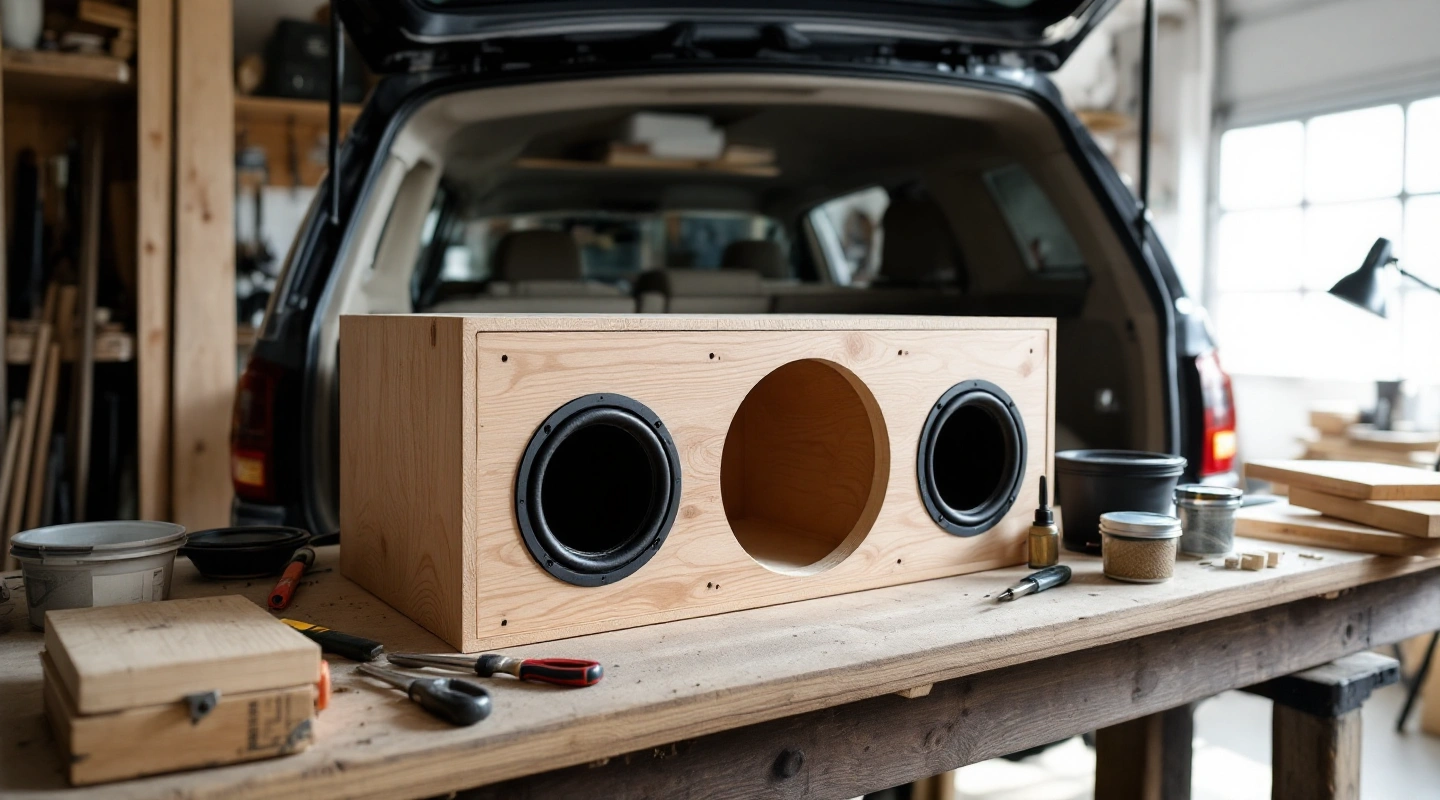
To work out how to build a wedge subwoofer box, define which wall slopes before choosing sizes. This guide uses a vertical front, horizontal top and bottom, and a sloped rear. That layout lets you work out cavity volume without treating the rear wall's normal thickness as a simple horizontal subtraction.
Start with the driver's stated airspace target and the available outline. A wedge is a prism with a trapezoidal side section. Use inside sizes for the easy volume math. If you measure outside, offset the sloping rear wall correctly. The volume worksheet does not choose joint bevels, driver location or safe vehicle attachments for you.
On this page
Define the wedge subwoofer box profile
Draw the side outline with a vertical front edge. Label outside height H, bottom depth Db and top depth Dt. The width W runs across the car. The top depth is measured horizontally, not along the sloping rear face. Record wall thickness perpendicular to the face of the board.
That measurement matters behind a tilted seat. A tape run along the seatback does not give the horizontal box depth. Check the seat through its required movement and leave the specified clearance. The box drawing describes a measured space; it does not establish a safe attachment to the seat structure.
If the front wall slopes too, or the sides taper across the width, this worksheet no longer matches the shell. Break the solid into measured sections or use a full geometric model. Do not force a different outline into the same five fields.
Work out the inside prism
For known inside sizes, average the inside top and bottom depths, then multiply by inside height and width. In inches, divide that product by 1728 to obtain cubic feet. This follows the basic prism method described in KICKER's box guide.
Outside measurements need another step. Let k = (Dt − Db) / H. The rear plane's horizontal offset is t × √(1 + k²), where t is its normal thickness. At the inner bottom and top, work out the depth to that offset plane, then subtract the front thickness b.
db = Db + kt − t√(1+k²) − b
dt = Db + k(H−t) − t√(1+k²) − b
Multiply (W−2t) × (H−2t) × (db+dt)/2. These formulas were derived from a parallel wall offset. When the rear becomes vertical, they return the rectangular inside sizes. That is an arithmetic limit check, not a physical test.
Work through a measured-outline example
Use a synthetic outside outline 20 inches wide and 12 inches high, with bottom depth 12 and top depth 8 inches. Let every wall, including the front, be 0.75 inches thick. The rear slopes about 18.435 degrees from vertical.
The inside width is 18.5 inches and the height is 10.5 inches. The computed bottom and top inside depths are about 10.209431 and 6.709431 inches. The resulting empty cavity is 0.950952 cubic feet. These sizes show the layout; no driver fit or acoustic target is implied.
If the installed driver occupies 0.040 cubic feet and measured braces plus terminals occupy 0.025, the sealed net airspace becomes 0.885952 cubic feet. Change any of those inputs and work it out again. Keep the rear wall's thickness separate from any extra front layer.
Use the wedge calculator to keep the full precision. Its printable output is a measurement worksheet. It does not provide an automatic bevel cut list because the panel joints have not been chosen.
Plan the joints and cutouts
Choose whether panels cap edges or fit between them, then draw each joint in section. The top and bottom meet the rear at different angles. Their finished sizes depend on the chosen joint, such as a butt joint or bevel. A side polygon alone does not settle those cuts.
Make a full-size side template from the checked outline. Compare the uncut driver's motor envelope with the sloping rear. The top of the motor can meet the rear even when the bottom has ample space. Use the frame and cutout sizes from the exact driver manual.
Ported wedges add another constraint. A vent that fits in the bottom may collide with the rear higher up. Check the whole duct and its opening clearance. A rectangular port calculator estimates acoustics; it does not prove a folded route through a tapered cavity.
Check the assembled wedge subwoofer box
Dry-fit the shell before bonding. Check the two side profiles against each other, then measure the inside height and both inside depths. Use those measurements for an independent volume check. A wall built at the wrong angle can still meet at the edges while changing airspace.
Follow the adhesive and saw makers' instructions for the actual sheet and cuts. OSHA's table-saw guidance covers blade-contact and kickback controls. Bevel setup requires the selected tool's own procedure, including workpiece control.
After cure, inspect the acute rear seams while they remain reachable. Complete the seal checklist. Do not treat a tight carpet finish as evidence that the box's inner joints are airtight.
FAQ
Can I average the outside depths?
That gives outside prism volume. It does not remove the front or sloping rear wall correctly. Use measured inside depths, or offset the outside profile by the actual wall thickness. The normal thickness of a sloping sheet is not generally the same as the horizontal space it occupies.
Does the worksheet supply bevel settings?
No. The worksheet shows the volume layout and slope. A saw setting also depends on the chosen joint and which panel covers the mating edge. Draw that joint before cutting. Treat the worksheet as a dimension record until you have checked the real panel layout.
Can I mount the driver on the sloped wall?
That changes the mounting plane and clearance checks used here. The cavity math may still describe the same shell, but the driver layout needs its own section drawing. Check the full frame and motor envelope, not only the cutout diameter. Do not assume the front-mounted example proves rear-mounted fit.
Can I use the same volume for a ported wedge?
Only if the exact driver's ported target calls for it and the entire vent fits. A vent uses cavity space and needs its own area, length and end treatment. Use a stated alignment, then check the space taken up again. Adding a port to this synthetic outline is not a validated acoustic design.
Verdict
The method for how to build a wedge subwoofer box starts with its profile, then airspace and joints. Check the inner taper with a section drawing before cutting bevels. Return to the box planner for a rectangular alternative.