
Construction and materials
Kerf Subwoofer Box
Last updated
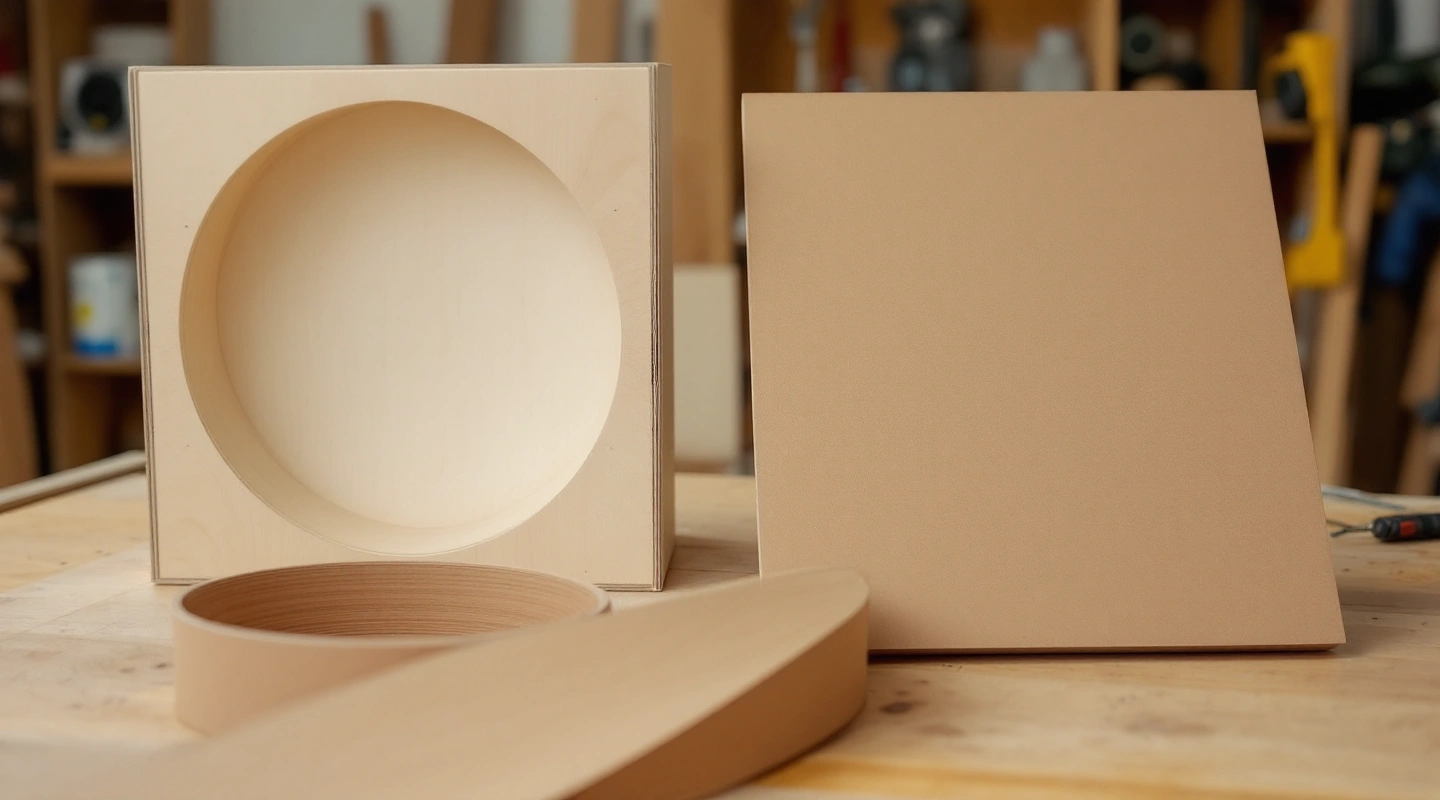
A kerf subwoofer box uses closely spaced cuts to let a panel bend. That can make a curved wall or vent path, but the cut pattern also changes stiffness and sealing. Plan the actual inside curve and remaining material before counting volume or copying a bend from a photograph.
A kerf bend needs a defined radius, arc and joint method. Separate the clear inside curve from the board's outside face. Count the remaining material and any reinforcement once in the volume ledger. There is no fixed cut spacing or remaining-skin thickness here: those depend on the exact sheet, saw and verified bend method.
On this page
Define the kerf subwoofer box bend before cutting
Write the inside radius and the angle the bend turns through. A quarter-circle turns through 90 degrees. Its inside arc length is πr/2. A curve with an uneven radius needs a measured profile; calling it a quarter-circle would give the wrong area.
Identify the surface you are measuring. Inside radius controls cavity or duct clearance. Outside radius includes the bent panel's remaining thickness and any added layers. The duct centerline can help describe its route, but it is not the same as either face.
Choose the material and make a separate sample bend before committing a final panel. Measure the sample rather than assuming the saw's labeled kerf or the sheet's nominal thickness. This page does not give a cut-depth recipe that might leave the panel too weak.
Check the volume of the curve
Curved walls can be modeled by dividing the side section into simple areas. A quarter-circle area is πr²/4. Multiply a section area by the constant width to obtain a prism volume. Use the actual inside profile for the cavity.
In a synthetic corner example, a 6-inch-radius quarter-circle has area 28.274334 square inches. The surrounding 6 × 6 square has area 36 square inches. The difference is 7.725666 square inches. Across a 12-inch width, that difference is 92.707993 cubic inches, or 0.053650 cubic feet.
Which area you add or remove depends on which side of the arc contains the air. Sketch and label the air region first. A rounded outside corner and an inward-projecting rounded insert do not produce the same correction even when their radii match.
Keep a ledger of the pieces. If the curved wall replaces a straight wall already included in the shell model, account for the replacement rather than subtracting both. Braces or laminated strips inside the new cavity add their own space taken up.
Keep the slot vent clear area separate
For a curved slot, measure the free width and height along the whole path. A small inside radius can create a restriction even when the opening is large. The panel thickness is part of the construction envelope, not the clear acoustic area.
Use the port area guide to check the opening first. Then add the space taken up by the vent. Count each inside wall once. Do not subtract a shared cabinet wall twice.
A curved route also affects the acoustic estimate. UNSW's Helmholtz explanation distinguishes effective length from physical length. It does not supply a fixed folded-slot correction. The port calculator therefore needs a stated or clearly entered correction for such a design.
Plan the cut method from the actual tool
Decide how the workpiece remains controlled for every cut. Read the selected saw manual and keep the intended guards in use. OSHA's table-saw page shows blade-contact and kickback hazards that apply to repeated cuts as well as a single crosscut.
Do not use a borrowed spacing figure as proof that your board will bend. Veneer direction, sheet defects and the remaining outer skin can alter the result. If the sample cracks, revise the method. Filling that crack does not prove that the weakened panel is sound.
Keep dust extraction in place for each cut. Measure the final curve after the glue and added support have set. The wood may spring back from the former. That changes the cavity area and the gap around the vent.
Check the subwoofer box seams and reinforcement
Kerf slots can be leak paths. Choose a stated bond and reinforcement method for the selected board. Do not assume that decorative covering seals open cuts. Inspect both ends of the bend and its junction with the flat panels.
Measure the added support in its final place. A broad inner layer changes the clear radius. A rib adds stiffness and takes up space. Update the math from the finished curve, including those parts.
For a box wall, compare the finished cavity with the driver's stated target. For a vent wall, recheck clear area and the full route, including its correction assumptions. A smooth curve alone does not establish tuning or a noise-free power limit.
FAQ
What kerf spacing should I use?
This guide does not assign one. The cut width, remaining skin and material behavior need to match the actual board and tool. Follow a stated method and measure a sample bend. A number copied from another build can produce a different radius or a cracked outer face.
Does a kerf bend increase box volume?
It depends on which part of the air region the curve replaces. Draw the original and final inside outlines, then work out their section-area difference. Multiply by the shared width. Do not infer the direction of the volume change from the outside appearance or the length of the bent board.
Is a curved slot by itself quieter?
The curve alone does not establish a noise reduction. Clear section, drive level and the whole vent path matter. This guide does not calculate air velocity or maximum clean output. Read the exact vent documents and inspect the finished route for restrictions, loose material and changes at its ends.
Can I use the rectangular cut sheet for this?
Only for flat shell pieces whose joints still match that cut sheet. It does not describe a kerfed panel or its former. Keep a separate curve drawing and volume correction. Calculate the net cavity again once the bend, added layers and inside partitions are defined.
Verdict
A kerf subwoofer box needs a measured curve and a sound build method. Work out the air region from that inside curve. Check the actual bend before closing the box. Use the bracing ledger to count added inside parts.