
Fit and worked designs
Subwoofer Box Too Small
Last updated
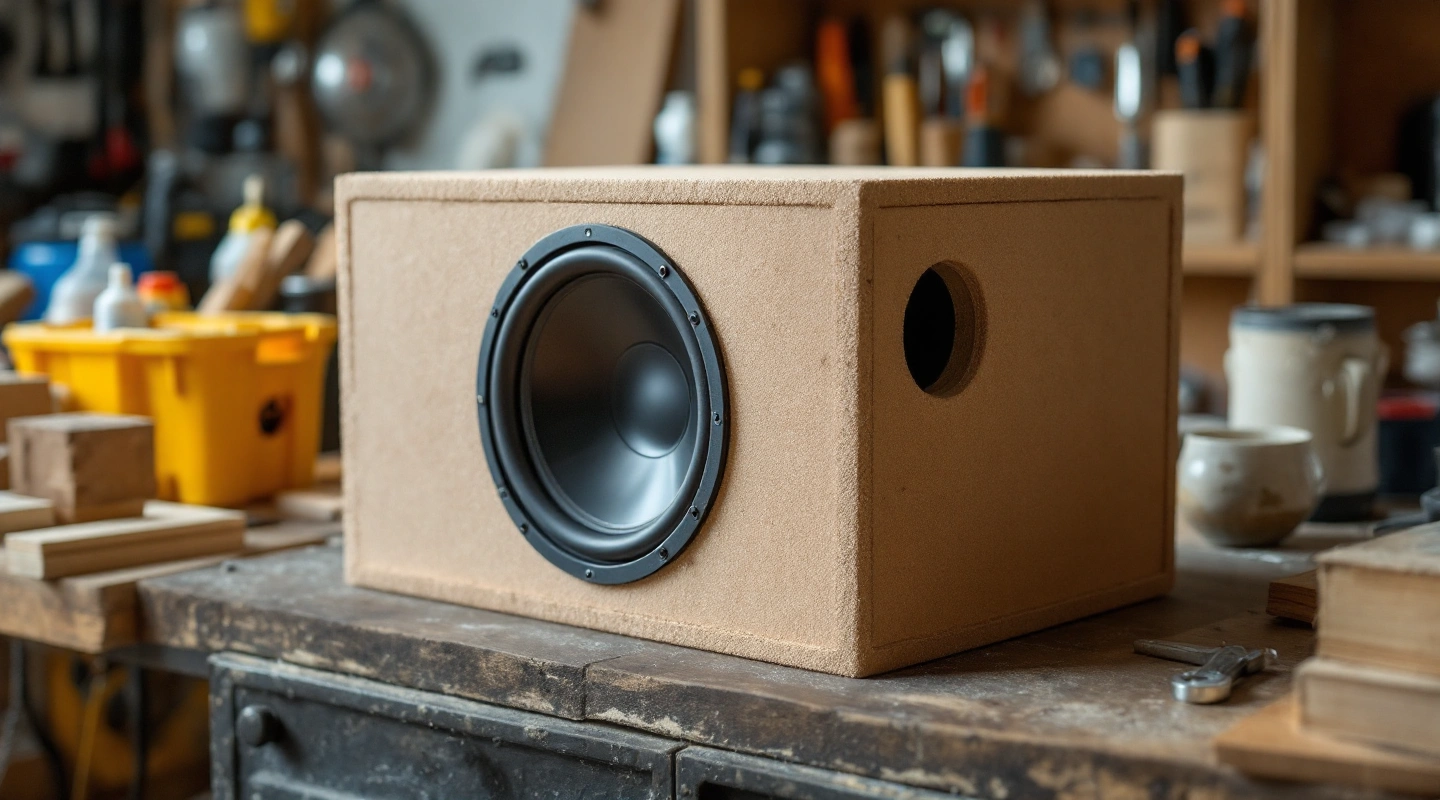
A subwoofer box too small for its driver may lack net airspace, mounting room or vent clearance. Check those problems separately. A larger shell does not always fix a blocked port. A spacer may create motor clearance without supplying the required airspace.
Measure the inside cavity and subtract the installed parts. Compare that net result with the exact manual's convention. In a sealed model, reducing net volume raises computed Qtc and Fc. In a ported box, check the vent and tuning as well. Keep unknown displacement visible and do not use an assumed fill bonus to hide missing airspace.
On this page
- Is the airspace or mounting space too small?
- Audit the volume ledger
- Check the sealed result when airspace is too small
- Check a ported box as a complete alignment
- Choose a revision that fixes the cause
- Turn a measured shortfall into a depth check
- Recheck fit after moving the front plane
- Decide whether the evidence is complete enough
- FAQ
- Verdict
Is the airspace or mounting space too small?
Start with the symptom and a drawing. A motor touching the rear wall is a fit failure. A published target exceeding the measured net cavity is an airspace mismatch. A brace across a vent entrance is a route restriction. One box can have more than one problem.
Check the full driver code and mounting plane. A shallow series and a regular series can share nominal diameter while differing in the space they need. Use the physical sizes in the exact manual, including the frame and any stated rear clearance.
Do not run the driver at high level while investigating contact or rubbing. Inspect the parts and cable route with the system disconnected according to its instructions. A volume equation cannot diagnose a damaged driver or an amplifier fault.
Audit the volume ledger
Measure finished interior width, height and depth, or work them out from outside measurements and actual wall thickness. For a wedge, use the sloped-wall worksheet rather than one rectangular depth.
List occupied driver volume, brace material and terminals. For a vented box, include the whole inside duct envelope that is excluded from the compliance airspace. Count shared cabinet walls only once. A measured cavity is not final net airspace until these entries are complete.
For a synthetic audit, a 1.20-cubic-foot empty cavity contains 0.06 of driver displacement, 0.04 of bracing and 0.01 of terminal hardware. Remaining sealed airspace is 1.09 cubic feet. Against a hypothetical true-net target of 1.25, the shortfall is 0.16 cubic feet.
That target is invented only for arithmetic. Use your real manual for the actual comparison. The size reference also shows why an included-driver target must not be read as a true-net figure.
Check the sealed result when airspace is too small
The ideal closed-box relation is Qtc = Qts × √(1 + Vas/Vnet). Less net volume makes the multiplier larger. System frequency Fc uses the same multiplier on Fs. The source is the closed-box engineering note; its model is small-signal and ideal.
For a synthetic driver with Fs 30 Hz, Qts 0.4 and Vas 50 liters, a 10-liter box gives Qtc about 0.980. A 30-liter box gives about 0.653. This checks the direction of the relation without assigning either box to a real product.
Use the sealed calculator to compare a stated model. A changed Qtc is not a listening-test score. The model does not predict the vehicle's response or prove a safe amplifier setting.
Check a ported box as a complete alignment
A vent needs a clear passage and a suitable alignment. A long duct can use a large share of the cavity even when the outside size matches the plan. Check both openings for obstructions, including a brace or a loose cable. A nearby wall can also restrict the path.
The port calculator uses true net cavity, not the empty shell. Keep the port's physical and effective lengths separate. Slot, flare and folded designs need their stated or clearly entered correction assumptions.
Do not cut a shorter port simply to recover some occupied space without recalculating the alignment. The change also affects tuning. KICKER's box guide explains why the vent and cavity must be designed together.
Choose a revision that fixes the cause
If airspace is short, solve a revised outside dimension from the correct target and final deductions. Keep the width and height fixed only if the mounting layout still fits. The homepage planner can solve rectangular depth after you enter the convention.
If the motor lacks clearance, a new mounting position or shell layout needs a fresh section drawing. A spacer changes the mounting plane and may add cavity, but its real inside opening and seal matter. Do not assume its outer ring volume becomes usable airspace.
For a restricted vent, revise the whole route and net ledger. If a suitable box cannot fit the vehicle's measured space, a different stated driver/box combination may be needed. Do not promise that fill or a generic adapter will overcome every limit.
Turn a measured shortfall into a depth check
The synthetic ledger above lacks 0.16 cubic feet against its hypothetical net target. Suppose that shell is rectangular, with outside width 20 inches, height 14 inches and 0.75-inch walls. Inside width is 18.5 inches and height is 12.5. These are new example dimensions, not a recommended box for an unnamed driver.
The required gross cavity is the 1.25 net target plus the same installed deductions: 0.06 for the driver, 0.04 for braces and 0.01 for the terminal. That adds to 1.36 cubic feet gross. The old cavity was 1.20, so the empty shell needs the same 0.16-cubic-foot increase while those parts remain fixed.
With width and height held constant, each added inch of inside depth adds 18.5 × 12.5 / 1728 cubic feet. The required increase is 0.16 × 1728 / (18.5 × 12.5), or about 1.195589 inches. This solves the airspace gap only. Check the longer box against the measured vehicle envelope before choosing it.
If the vehicle allows just one more inch, the added cavity is about 0.133825 cubic feet. That leaves a shortfall of about 0.026175 cubic feet under these assumptions. A rounded label saying the box is nearly large enough would hide the remaining difference. Save the exact values before rounding the drawing.
This example keeps the deductions fixed to isolate the depth change. A longer brace, revised terminal or new vent would alter that assumption. Update those entries before accepting the new depth. The final construction plan needs both the acoustic ledger and the actual panel layout.
Recheck fit after moving the front plane
A spacer moves the driver's mounting plane. Draw where the frame, cutout and rear of the assembly will sit after the change. A ring with a narrow inside opening may obstruct part of the basket even when its outside diameter looks large enough. Its seal and fasteners also need a suitable mounting surface.
Count added airspace from the actual hollow opening that joins the cavity. Do not count the ring's solid material as air, or assume that every part of the recess is open to the box. If the geometry is irregular, keep that contribution unknown until it can be measured or derived from a drawing.
Recheck the front clearance too. Moving a driver outward can place its surround or cone nearer the grille or seat. Cargo may obstruct it as well. The old rear-depth problem may be gone while a new front obstruction appears. This site's shell dimensions cannot establish those external moving-part clearances for you.
Decide whether the evidence is complete enough
Separate measured entries from guesses before calling the box undersized. If brace volume is unknown, the net result is still incomplete. Measure the solid pieces or obtain their dimensions. An assumed zero would erase a real deduction and make the apparent gap smaller.
When a measured input has a documented range, calculate both ends of that range. If both results miss the target, the shortfall does not depend on the last displayed decimal. If the range crosses the target, record that uncertainty and improve the measurement. Do not assign an arbitrary tolerance merely to make a close result pass.
FAQ
Can polyfill make a small box large enough?
This site applies no fixed fill allowance. Acoustic effects depend on the design and do not repair physical clearance or a blocked vent. Use the driver's stated damping instructions. Keep measured net layout separate from any modeled treatment, and do not claim that an arbitrary amount of fill fixes a volume shortfall.
Does a thicker baffle make the problem worse?
It reduces cavity depth when added inward within a fixed shell. It also changes the mounting plane, so check both airspace and fit again. An outward extension or spacer has different geometry. Draw the actual opening and joint before applying a thickness correction from another front-panel layout.
Can I remove braces to gain space?
Do not remove structural material just to make the volume number pass. Check the stated construction and unsupported spans first. A revised brace layout needs its own fit and occupied-volume ledger. Losing stiffness or creating a loose joint can introduce a different problem without establishing a valid acoustic design.
Why does the listing's volume disagree with my result?
The listing may describe gross cavity, true net airspace or a rounded figure with unnamed deductions. Measure the shell and request the volume definition before deciding it is wrong. Keep that uncertainty in your record. A bare cubic-foot label does not establish which parts have already been allowed for.
Verdict
Diagnose a subwoofer box too small by separating net volume, driver fit and vent clearance. Revise the cause you can show, then check the complete box again. Save both plans so the changed assumptions remain traceable.