
Ports and tuning
Ported Subwoofer Box
Last updated
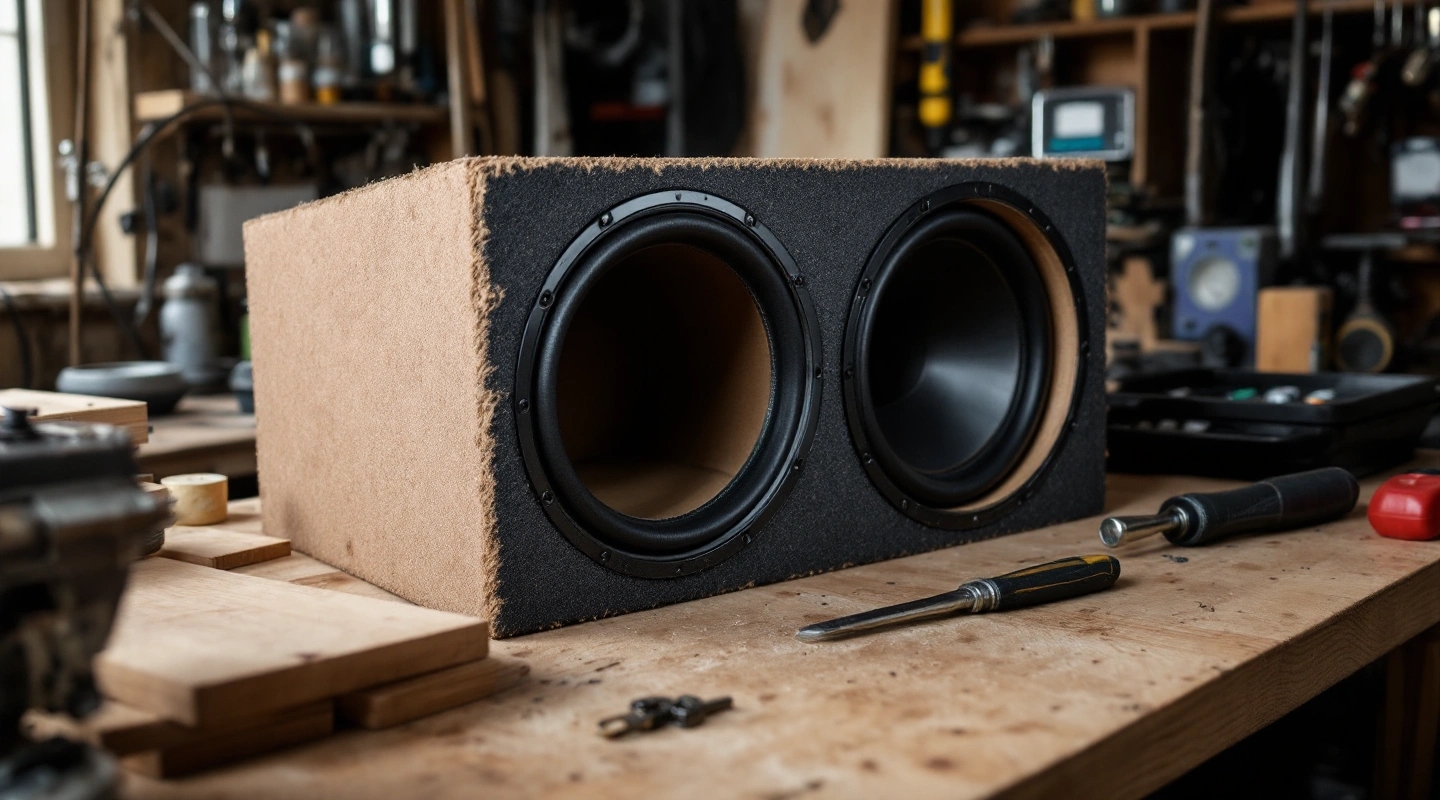
A ported subwoofer box is a cavity and vent designed to work with a particular driver. The vent has a stated clear section and effective length. Its whole inside volume must fit inside the shell while leaving the required net airspace. A box with an opening is not by itself a suitable vented box.
Choose a stated vented alignment for the exact driver. Keep true net airspace separate from gross cavity and any target that already includes driver displacement. Check the whole vent route and both openings before cutting. Computed tuning is a rough small-signal result, not a guarantee of low bass, maximum output or safe power.
On this page
What the vent adds to the design
The air in a duct participates in the box's low-frequency behavior. Its interaction with the cavity gives a tuning frequency often labeled Fb. The UNSW Helmholtz explanation provides the rough physical relation used by this site's port tool.
The driver and box still need to be treated as a system. KICKER's box guide discusses the reduced cone control below vented tuning. Do not treat a lower computed Fb as a blanket improvement or safe operating condition.
Start with the maker's design where available. Cone diameter alone does not tell you the target cavity or vent. An unnamed ported box needs the same checks. Its fit stays unknown until you have the source target and actual sizes.
Read ported subwoofer box volume conventions
Gross cavity means the empty inside shell. True net airspace remains after installed parts are deducted. Some makers state targets that already allow for the driver but exclude the port. A seller's bare cubic-foot label may not tell you which quantity it describes.
For a synthetic ledger, let the empty cavity be 2.00 cubic feet. The driver and other fixed parts occupy 0.10, and the inside port envelope occupies 0.25. The remaining acoustic airspace is 1.65 cubic feet. Calling that shell a two-cubic-foot net box would misstate the math.
Use the box planner to keep each deduction. A missing occupied-volume field stays unknown. The model size chart includes source conventions so you can compare the same quantity rather than only the same unit.
Check the ported subwoofer box vent layout
Clear area uses a round tube's inside diameter or a slot's free width and height. Space taken up uses the actual inside envelope, including the tube wall or inside slot partitions. These are separate measurements.
Effective acoustic length includes end effects. Physical length is the actual duct. A round opening's correction assumes a stated end layout. Slots and flares may need a different treatment. The port calculator prints the chosen assumption.
Lay out the complete path around the motor, braces and terminals. Check the inlet and outlet clearance from the applicable documentation. The front opening can fit while the duct collides inside the cabinet. A proposed fold also needs a documented or stated acoustic treatment.
Work from a complete source example
The KICKER CompR manual shows a vent envelope added to an included-driver target. The JL 12W0v3 manual labels its target as net inside volume. Neither convention should be inferred from the brand alone.
The CompR guide and JL guide keep those volume definitions. Each refers to an exact manual. An old design example does not prove that the model is still sold. It does not show that a later product uses the same box.
Keep the full source row with your plan. Volume alone is not a complete design. Keep its vent, units and included parts too. If the source figures disagree, record the gap. Do not invent hidden parts to make the numbers match.
Decide what the math can tell you
The geometry gives cavity volume and shell sizes. The ledger shows what each part takes away. The acoustic equation estimates tuning from true net airspace and the chosen vent model. It does not model the full cabin response, cone travel or airflow noise.
Keep maximum clean power and vehicle fit unknown when those checks are absent. A green volume comparison is not evidence that the motor clears the vent. A computed 30 Hz label is not a promise that the system plays every note cleanly at a chosen level.
Read the tuning guide before checking Fb. It shows how to put a solved length back into the equation. It also links to low-level impedance methods for a real measurement. This site claims no physical test.
Build and inspect the actual box
Measure board thickness and settle the joint layout before cutting. Dry-fit the duct and inside parts before the last panel closes. Check that assembly details have not reduced the clear section or obstructed either opening.
Inspect the driver gasket, terminal flange and all unwanted seam paths after the stated cure. Keep the designed vent open. Use the ported sealing guide if an inside duct seam or flange needs attention.
Secure the box as the vehicle and attachment instructions state. The calculator gives no generic drilling location. It checks only the entered layout. It does not check the strength of the vehicle or its box restraints.
FAQ
Is a ported box better than a sealed box?
Choose from the exact driver's stated designs and your available space. No fixed sound-quality ranking is proved here. A ported alignment adds vent layout and operating checks, while a sealed box has its own target and limits. Compare complete designs rather than treating the box label as a listening verdict.
Does the port count as inside airspace?
Its inside envelope is excluded from the compliance airspace used by the vent equation. For a tube, use outside area over the length inside the cavity. For a slot, include duct air and actual inside partition material. Do not subtract shared cabinet-shell material for a second time.
Can I use a ported box with any subwoofer?
Do not assume fit. Check the exact driver's vented design and physical dimensions, along with its operating limits. A matching nominal diameter only identifies a size class. The net target and tuning still need evidence for that model. Keep unknown fit and alignment details visible until the proper document supplies them.
Why does a ported design need more than a volume target?
The vent's clear section and effective length are part of the design. Its route and occupied space also need to be defined. A volume label alone leaves those facts unknown. Use a full maker's example or state the model you used. Check the finished box against all its inputs.
Verdict
A ported subwoofer box is a complete cavity-and-vent design. Keep its source convention and physical route attached to the math. The ported construction guide takes that checked plan through assembly.